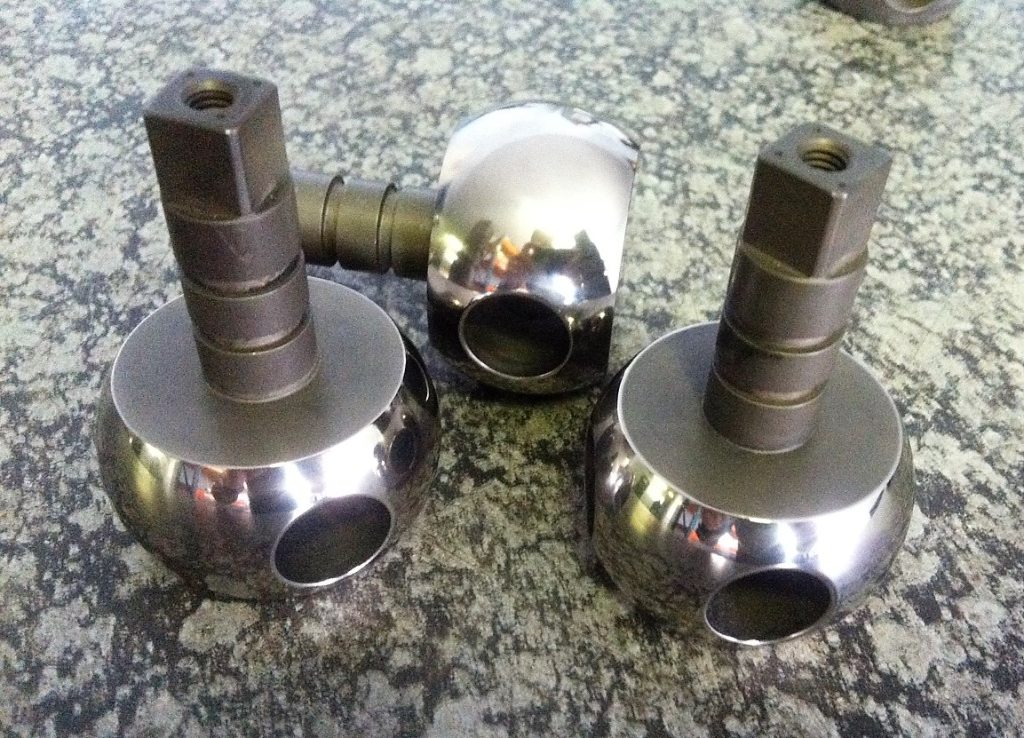
Boriding is a thermochemical surface hardening method that can be applied to various ferrous, non-ferrous, and cermet materials. It is designed to improve the life and performance of metal components. The process entails diffusing boron atoms into the lattice of the parent metal, subsequently forming a hard interstitial boron compound at the surface. The surface boride may be a single-phase or a double-phase boride layer.
Boriding is a two-step reaction. The first step reaction is between the boron-yielding substance or compound and the part, a function of time and temperature. This results in a thin, dense boride layer. This reaction is followed by diffusion, which is a faster process. The process is predominantly used to strengthen resistance to corrosion and abrasive wear, decrease the coefficient of friction, and significantly increase surface hardness.
At Metal Technology Engineering, we use a specially formulated boron-yielding powder. When heated to 700 and 1,000°C, the powder causes boron atoms to diffuse into the substrate, forming extremely hard borides in the material’s surface layers.
The depth of diffusion and hardness is time, temperature, and material dependent, but one can achieve depths of 0.12 – 0.5 mm and hardness of 1,400 – 1,900 HV (Vickers hardness).
Benefits
Boriding provides a uniform hardness layer from the surface onto the entire depth of the diffused layer. The hardness achieved is many times higher than any other surface hardening process. The combination of high hardness and low coefficient of friction enhances wear, abrasion, and surface fatigue properties. Other benefits associated with boriding are retention of hardness at elevated temperatures, corrosion resistance in acidic environments, a reduction in the use of lubricants and a reduced tendency to cold weld.
Application
Boriding can be carried out on most ferrous materials except aluminium and silicon-bearing steels. Steels that benefit from boriding are structural steels, case-hardened, tempered, tool, and stainless steels, cast steels, ductile and sintered steels, and air-hardened steels. In addition, materials such as nickel-based alloys, cobalt-based alloys, and molybdenum can be borid. Nickel alloys can be borid without sacrificing corrosion resistance, in addition to producing extreme hard surface wear resistance.
Contact Metal Technology Engineering for Details
Contact us today for more information about boriding.